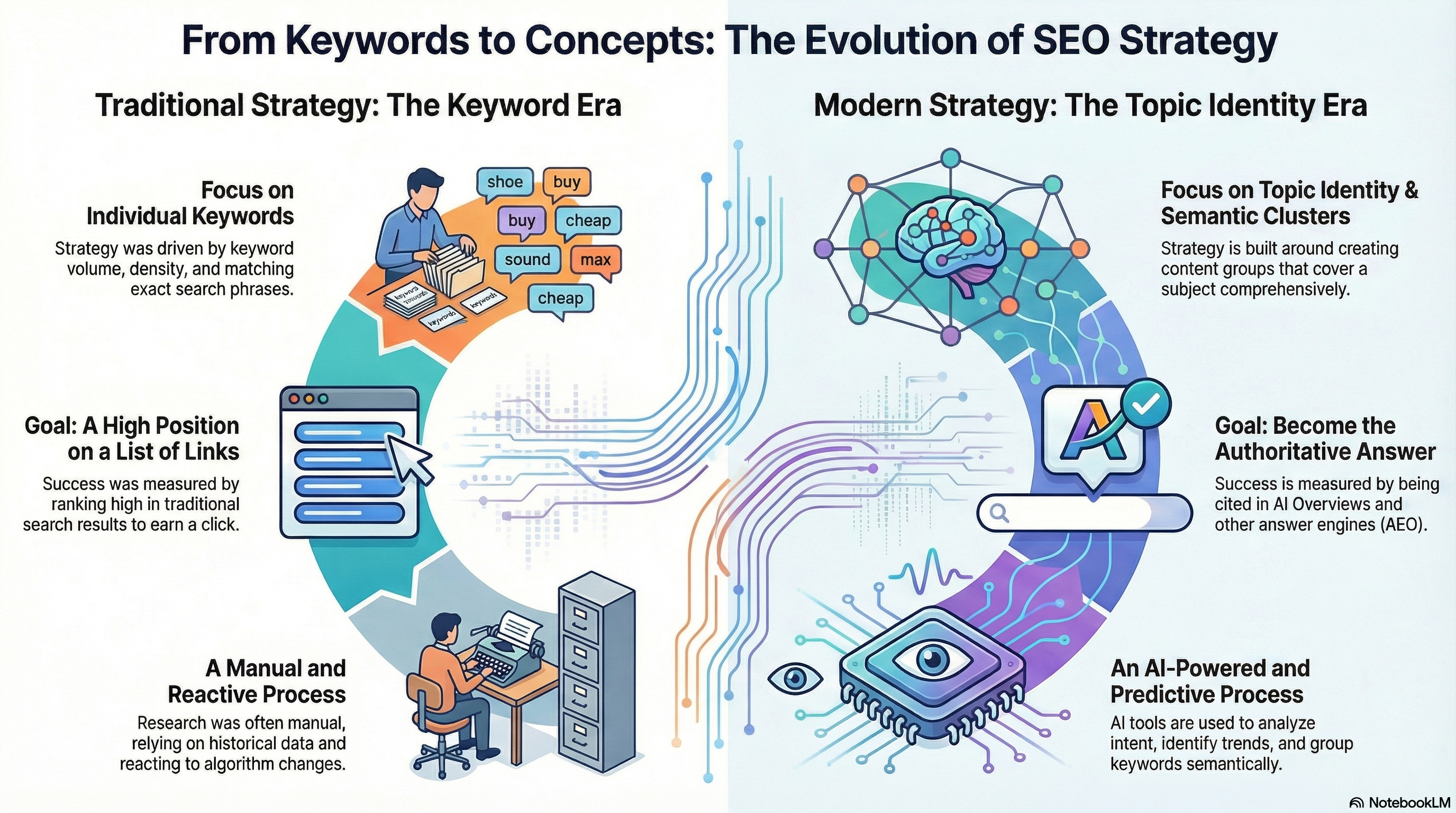
The SEO industry is undergoing a foundational shift driven by Artificial Intelligence Optimization (AIO), transforming the focus from chasing single keywords to achieving visibility across all digital platforms (Search Everywhere Optimization). This shift makes traditional CTR and ranking metrics secondary to earning citations and brand mentions.
Modern strategies must optimize for conversational queries and long-tail keywords to match user intent. AI automates keyword clustering into Topic Identities and content briefs, but human expertise is required to integrate Schema Markup, E-E-A-T, and the Answer-First Format to facilitate RAG (Retrieval-Augmented Generation).
What exactly is AI in SEO?
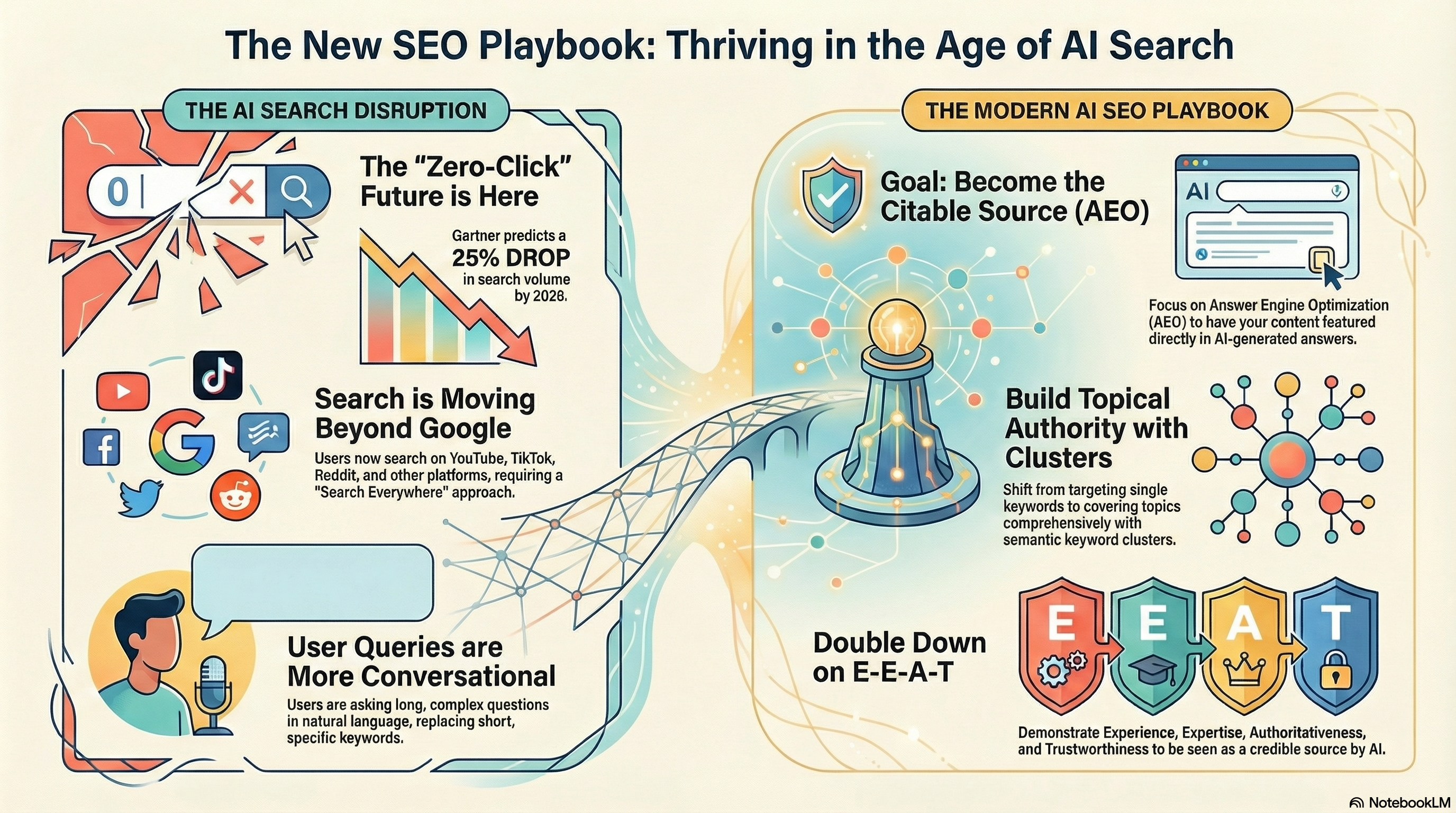
AI in SEO refers to using artificial intelligence technologies to analyze data, generate content, optimize websites, and improve search engine performance by automating tasks and providing insights that help increase rankings and visibility.
1. How AI is changing SEO
AI is transforming SEO by automating optimization, analyzing data, and generating content to improve search rankings and user experience.
| Aspect | Traditional SEO | AI SEO / AEO |
|---|---|---|
| User Interaction | Search using specific keywords. | Questions in natural language. |
| Content Focus | Keyword density, technical structure. | Quality, clarity, reliability (E-E-A-T) |
| Success Metrics | Clicks, rankings, traffic. | Citations, brand mentions, AI visibility. |
| Primary Output | Blue links. | Direct answers and AI-generated summaries (AI-ready structured data). |
| Strategy | Optimize for Google (SEO). | Search Everywhere Optimization (SEO + AEO + GEO). |
2. How AI search find your answers, the RAG pipeline
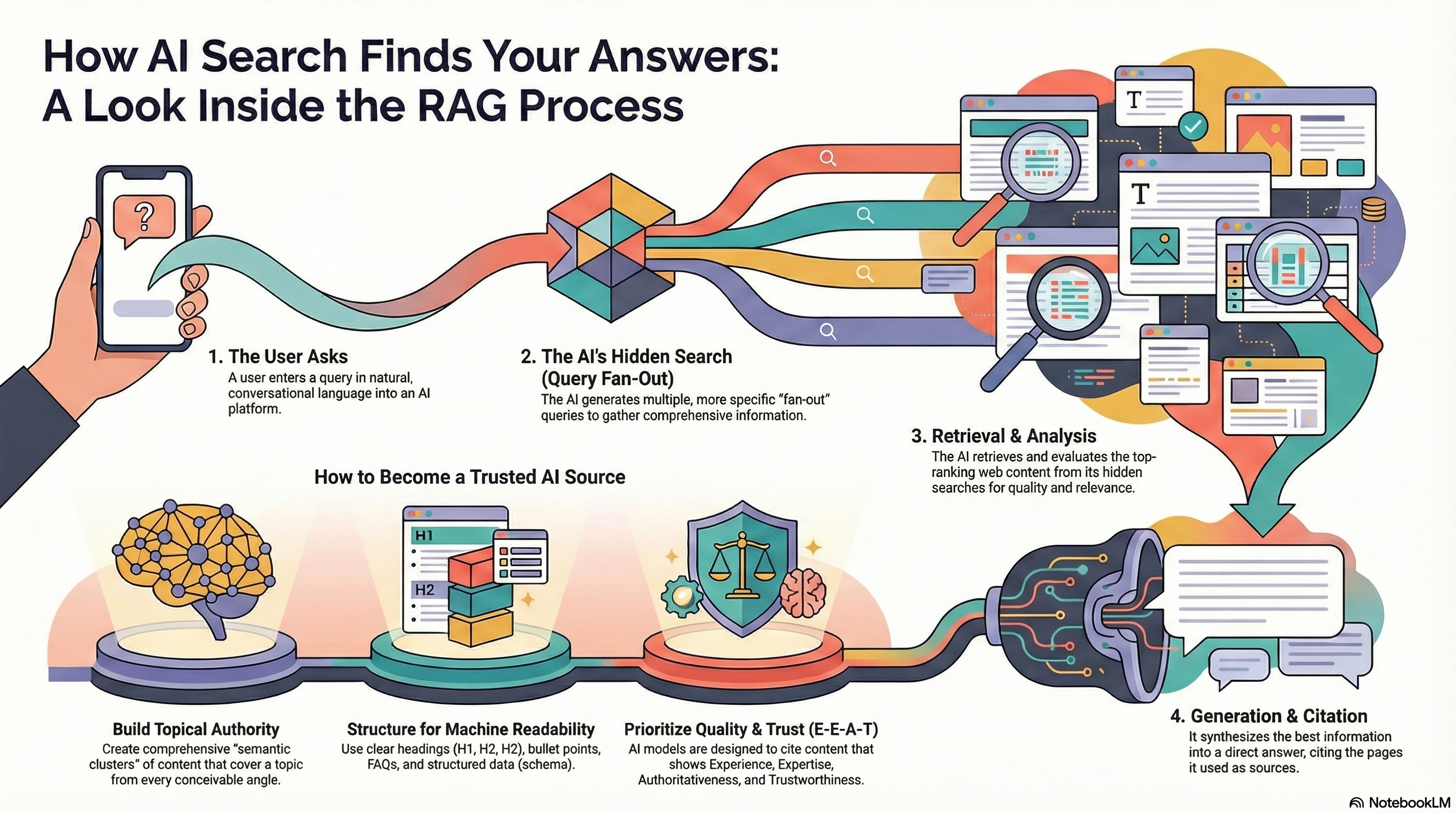
AI search finds your answers by analyzing your query, retrieving relevant documents, and generating responses based on the information it has learned or accessed.
The RAG (Retrieval-Augmented Generation) pipeline combines document retrieval with AI generation, letting the model pull in external data before producing accurate, context-aware answers.
| Stage | Action / AI Requirement | Optimization Focus (Your Content) |
|---|---|---|
| 1. Retrieval (RAG) | AI performs Hybrid Search (lexical + semantic) and may trigger Query Fanout. | Build Topical Authority and Semantic Clusters to appear in the search results used for retrieval. |
| 2. Grounding | AI validates information against credible sources to ensure factual accuracy and prevent hallucinations. | Demonstrate E-E-A-T (Expertise, Trustworthiness) and use transparent sourcing. |
| 3. Generation | LLM synthesizes the selected data into a concise, natural language response. | Use the Answer-First Format, Schema Markup (FAQ, HowTo), and clear headings for easy extraction. |
3. How to optimize for AI search engines for SEO?
To optimize for AI search engines, create high-quality, structured, and context-rich content that clearly answers user questions and includes Schema.org markup. Focus on semantic relevance, authoritative sources, and well-formatted text so AI can accurately retrieve and generate responses from your site.
| Keyword Archetype | Intent (Why they search) | Optimization Goal (How you use it) |
|---|---|---|
| Short-Tail (e.g., Digital Marketing) | Broad topic definition. | Forms the top-level Topic Identities under which niche content nests. |
| Long-Tail (e.g., best budget cloud computing services) | Higher intent, niche, transactional query. | Focus for high ROI/conversion; aligns with complex, conversational user prompts. |
| Question-Based (e.g., how to optimize local data for maps) | Explicit inquiry seeking direct answers. | Essential for AEO (Answer Engine Optimization); optimize using clear FAQs and lists. |
How to future-proof SEO strategy against AI Overviews.
The prominence of Google’s AI Overviews (AIOs) and the subsequent rise of zero-click searches are reducing organic traffic to websites, necessitating a strategic shift focused on achieving visibility through citations and answers rather than just clicks. Forward-thinking SEO involves understanding and optimizing for these generative AI features to mitigate potential traffic drops. This includes improving E-E-A-T signals and increasing content specificity to appear as a reference link in the answer box.
Why traditional SEO metrics are declining in 2025.
Traditional success metrics like clicks and ranking positions are becoming insufficient because over half of searches may end without a click. Gartner predicts that traditional search engine volume will drop by 25% by 2026 due to AI platforms and virtual agent usage. Search analytics often show a phenomenon where website impressions are going up, but clicks are going down, reflecting the effectiveness of AI in answering queries instantly. Success must now be measured by citations, brand mentions, and AI visibility.
To build a complete strategy, ensure your content is supported by a strong Technical SEO foundation and external Off-Page SEO authority signals.
Strategies for earning AI citations and brand mentions.
The new primary goal is Answer Engine Optimization (AEO), which focuses on earning citations, brand mentions, and visibility within AI-generated responses. Winning this visibility requires clear language, structured content formats (like FAQs and lists), and building authority signals across the web. Specifically, Schema Markup and using a direct Question/Answer format are crucial, as AI models use these structures to accurately parse and cite content. Furthermore, strong evidence suggests that brand mentions across the broader web correlate highly with brand mentions in AI Overviews.
Optimizing content for conversational AI search queries.
User interaction has shifted from specific keywords to questions in natural, conversational language. User prompts given to AI platforms are often longer and more complex, with an average length of 42 words in some studies. This dictates a focus on long-tail queries (four or more words) that imply lower competition and higher conversion potential. To optimize effectively, content must adopt a conversational style that directly answers these complex questions, which often align with voice search queries.
What is Search Everywhere Optimization and why adapt.
Search Everywhere Optimization (SEO Everywhere) is the strategy of ensuring visibility across all search destinations where your audience seeks answers, not just Google. Adaptation is necessary because traditional SEO is not dying, but simply spreading out, as attention is fragmented across LLM chat platforms, YouTube (the second largest search engine), Amazon, Reddit, and TikTok. Businesses must shift from being "one trick ponies" (focusing on a single platform) to optimizing for multiple channels simultaneously.
Future-proofing SEO strategy
Focus on citations, brand mentions, and AI answer boxes to mitigate organic traffic loss due to AI Overviews. Internal linking to technical SEO factors strengthens topical authority.
Explicitly structuring content to be "grounding-ready" for LLMs to prevent hallucinations.
In AEO optimization is important the Answer-First Format.
To earn AI citations, use a direct Question/Answer format in your introductory paragraphs. This facilitates the RAG pipeline by providing clear text for AI generation.
Implementing E-E-A-T for credibility
Explicitly show E-E-A-T via author credentials, first-party research, and credible sources to reduce AI hallucinations. Link to Technical SEO accessibility practices to boost trust signals.
Technical foundations like E-E-A-T signals help reduce AI hallucinations by providing grounded, credible data sources.
Once your technical foundation is secure, focus on On-Page SEO to optimize content, and Off-Page SEO to build external authority.